

Blog
How to Buy a Suppressor: A Plain-English Guide to How It Works Now
Gun Search Engine·
- suppressors
- nfa
- buying guide
Getting a suppressor is simpler than it used to be. This guide explains how it works now, in plain words, and why your local dealer is still step one. You can see suppressor listings on Gun Search Engine while you read.
Per ATF guidance as of October 2026; rules may change. Check your state and local rules with your local dealer before you buy.
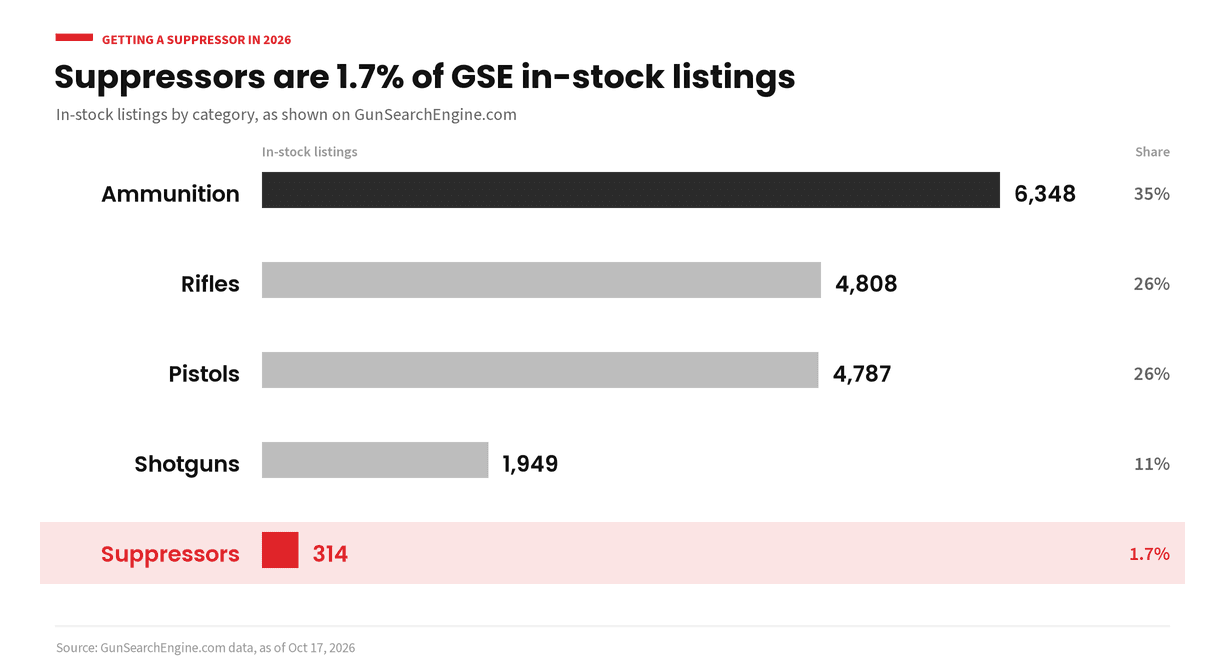
The chart at the top shows how suppressors compare with the other big categories listed on Gun Search Engine.
What a suppressor does and doesn't do
A suppressor, also called a silencer or a can, threads or clamps onto the muzzle and slows the hot gas leaving the barrel. That takes the edge off the sound of each shot and the blast you feel at the bench. It is easier on your hearing and on the people next to you.
It does not make a gun silent. A suppressed rifle is still loud, and most shooters still wear ear protection with one.
“A suppressor makes a gun quieter. It does not make it silent.”
What changed
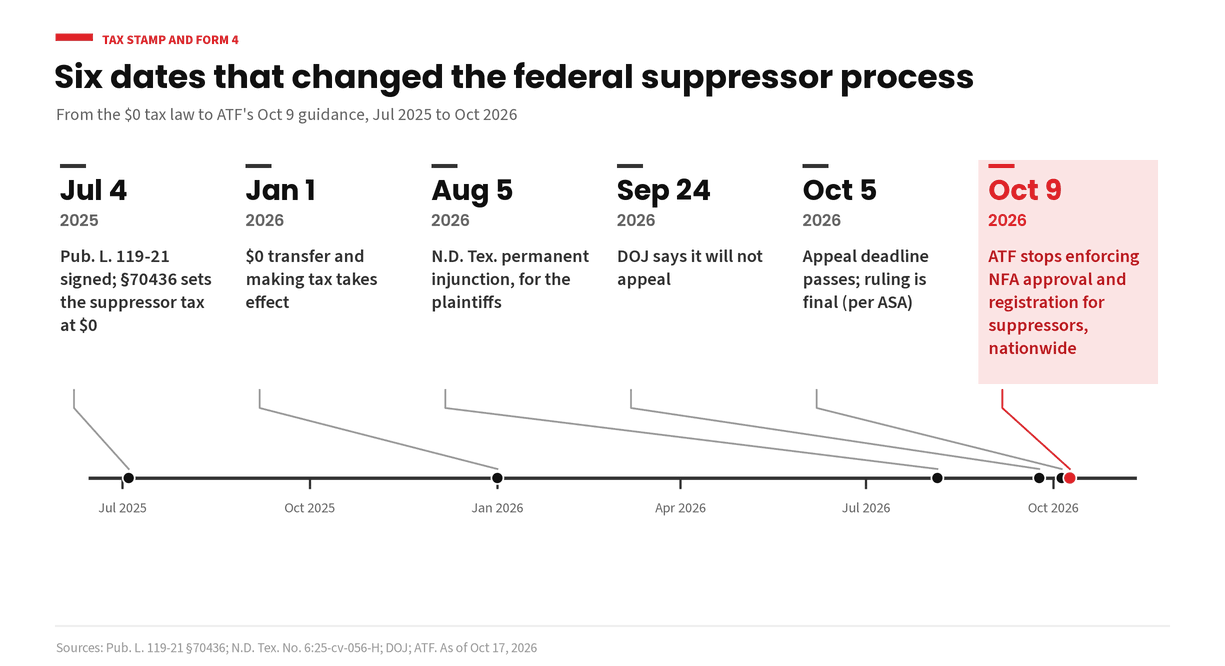
For a long time, getting a suppressor meant a federal tax, a federal approval wait and a registration step before you could take it home. That has changed in three steps.
- The tax went to zero. Earlier this year, Congress cut the federal tax on suppressors to zero.
- A court ruled against the old paperwork. With the tax gone, a federal court ruled that the federal approval and registration rules could not be enforced for suppressors against the people in that case. The government chose not to appeal.
- ATF extended it to everyone. ATF then said it will stop enforcing the federal approval and registration steps for suppressors nationwide, not only for the people in the lawsuit.
Machine guns are a different story. They still carry the federal tax and the full federal process. The dates and the official documents are in the Sources list at the end of this post.
“The federal tax is gone and the federal approval wait is not being enforced. Your state's rules still apply.”
How it works at your local dealer
- Check your state first. Some states ban suppressors outright, and some only allow ones that are registered under federal law. Your dealer knows the rules where you live.
- Find a dealer who handles them. Not every gun shop carries suppressors. Browse suppressor listings to see which dealers do, then call ahead.
- Pick a can that fits your caliber. Every suppressor is rated for a largest caliber. You can shoot smaller rounds through it, never bigger. A rimfire can for .22 LR is a common first choice. Pistol cans are often built around 9mm, and rifle cans around 5.56 and up.
- Fill out the background check form. You complete the same federal form and instant background check you would for any gun from a dealer.
- Ask about registration. If your state still wants the item registered under federal law, your dealer can help you file a Form 4. Anyone can also choose to file one.
Makers like Dead Air and SilencerCo sell pistol, rifle and rimfire models. We don't endorse any one maker. Fit and use matter more than the logo. Slower, subsonic ammo is quieter through any can, which is why subsonic rifle rounds are popular with suppressor owners.
“Your state's rules come first. Your caliber comes second.”
Common questions
- Can I take it home the same day? Under the current federal guidance, a dealer can hand it over once your background check clears, the same as a gun. Your state may add its own steps, so ask your dealer.
- Can I get one in another state? With limited exceptions, a dealer can only sell a suppressor to someone who lives in the dealer's state. Expect to shop close to home.
- Do I still need a tax stamp? Not for a suppressor under the current federal guidance, because the federal tax is now zero. Machine guns still need one.
- What if the rules change back? They could. Right now ATF is choosing not to enforce parts of the law after a court ruling. That is a policy choice, not a new law, and other courts could see it differently. Some owners file a Form 4 anyway so they have the paperwork if things change.
- Is a suppressor legal everywhere? No. Some states ban them, and some limit where you can use one, including for hunting. Check before you buy.
The bottom line
Per ATF guidance as of October 2026; rules may change. The federal steps are much lighter than they used to be, but state and local law still decide what you can own and where you can use it. Your local dealer is your best source for what applies where you live.
Ready to look? See suppressor listings on Gun Search Engine, or browse makers like Dead Air and SilencerCo.
Sources
- Public Law 119-21 (One Big Beautiful Bill Act), section 70436, signed July 4, 2025: sets the federal transfer and making tax on suppressors at $0 from January 1, 2026
- Silencer Shop Foundation v. ATF, No. 6:25-cv-056-H (N.D. Tex.), memorandum opinion and order, August 5, 2026
- U.S. Solicitor General, letter to the Speaker of the House on the decision not to appeal, September 24, 2026
- ATF, Update to NFA Transfer Guidance (open letter and FAQs), October 9, 2026
- ATF, Open Letter to all federal firearms licensees and the public on NFA making and transfer requirements, October 9, 2026
- ATF press release: ATF issues guidance on National Firearms Act transfers, October 9, 2026
Where to shop
Shop the hubs
Browse live stock, or list inventory if you sell.
Related posts
October 18, 2026
Do You Still Need a Form 4 or Tax Stamp for a Suppressor? What Changed in 2026
The federal suppressor tax is zero and ATF is no longer enforcing federal approval and registration for suppressors. Here is what changed, what your dealer still does, and when a Form 4 still matters. Per ATF guidance as of October 2026.
- suppressors
- nfa
- form 4
- tax stamp
October 17, 2026
10mm Auto Explained: Full-Power, Subsonic and the Pistols That Shoot It
What the 10mm Auto cartridge is, how it relates to .40 S&W, the difference between full-power, lighter and subsonic loads, and what to look for in a 10mm pistol.
- ammo
- 10mm
- handguns
- calibers
October 17, 2026
20 Gauge vs 12 Gauge: Which Shotgun Fits You?
How 20 gauge and 12 gauge shotguns differ in recoil, weight and shell choice, and how to pick the right one for clays, birds or home defense.
- shotguns
- 20 gauge
- 12 gauge
- comparisons
October 17, 2026
.223 Remington vs 5.56 NATO: What's the Difference?
The .223 Remington and 5.56 NATO look the same but are loaded and chambered differently. Here is which rifles can safely shoot which round.
- rifle ammo
- .223 Remington
- 5.56 NATO
- comparisons
October 17, 2026
.357 Magnum vs .38 Special: What's the Difference?
Why a .357 Magnum revolver can shoot .38 Special but not the other way around, how recoil compares, and how to pick loads for the range or for defense.
- handgun ammo
- .357 Magnum
- .38 Special
- revolvers
- comparisons
October 17, 2026
Ammo Cost Per Round: How to Compare Boxes Fairly
Why the box price can fool you, how to figure cost per round, and what else to compare before you pick an ammo listing.
- ammo
- price per round
- how to compare
October 17, 2026
Ammunition Manufacturers: Who Makes What
A plain list of well-known ammunition makers, where they are based and what they are known for, with a link to each brand's live listings.
- ammo
- brands
- manufacturers
October 17, 2026
Gun Manufacturers A to Z: Who Makes What
An A to Z list of well-known gun makers, where they are based and what they are known for, plus how to read a model name, with a link to each brand's live listings.
- guns
- brands
- manufacturers
October 17, 2026
Steel-Case vs Brass-Case Ammo: What to Know
What steel-case ammo is, why it costs less, the common worries about extraction, range rules and reloading, and when brass is the better pick.
- ammo
- steel case
- brass case
- comparisons
October 15, 2026
Mobile shoppers, AI crawlers, and why Gun Search Engine leans in
People shop on phones. AI assistants crawl and summarize the aisle. Gun Search Engine is built for both: a mobile-first card UI and AI discovery that is welcome, not blocked.
- mobile
- AI discovery
- shopping hubs